

Can the Netherlands’ most English-proficient city turn its talent and digital expertise into an international SEO and AI-search advantage?
Summary
Groningen combines strong English proficiency, a large higher-education population and an established digital sector. However, these advantages have not yet developed into a clear international digital-marketing proposition. Using public data and a July 2026 review of ten Groningen agencies, this article examines where the real gap sits—and why the evidence supports calling it a fragmented opportunity rather than a market void.
Who It's For
This analysis is for international businesses, digital-marketing agencies, economic-development professionals and growth strategists evaluating Groningen's international potential.
Quick Details
- Reading time:10 minutes
- Word count:~2,300 words
- Analysis level:Intermediate
As I always emphasize, data visualization provides clarity that text cannot. Before proceeding, examine this interactive map. It visualizes the direct geographical presence of international businesses within the Netherlands. By mapping both Dutch-owned and foreign-owned entities and scaling them by their billions in valuation
Netherlands · corporate footprint
Where international business lands
Every marker is a company with operations on Dutch soil, scaled by group value. Hover a province to lift it; hover a marker to trace it back to its exact coordinate.
Boundaries: Natural Earth (public domain). Figures are indicative and set in the data module.
International Digital Marketing Potential in Groningen Netherlands
At first glance, Groningen seems unusually well equipped to serve international businesses. In the EF English Proficiency Index 2025, it scored 656—the highest result among the nine Dutch cities listed. The city also hosts around 63,000 higher-education students, while the University of Groningen alone reports 8,500 international students. Add a growing digital sector and a steady flow of internationally minded talent, and Groningen appears to have the raw material for a strong international digital-marketing hub.
But having the ingredients is not the same as turning them into a market advantage. In my July 2026 review of ten Groningen agencies, only five offered a genuinely usable English-language service experience. International capability clearly exists, but it remains uneven, fragmented and difficult for a foreign company to recognise. This article investigates that gap: whether Groningen is overlooking a real international opportunity—and what would be required to convert its English proficiency, talent and digital expertise into a trusted market-entry proposition.
Groningen looks almost purpose-built for international digital marketing.
It has the highest English score among the nine Dutch cities included in the 2025 EF English Proficiency Index. It has tens of thousands of students, an international university and dedicated digital-marketing education. A Groningen company has already built a €606 million European e-commerce operation from the north of the Netherlands.
Yet the city has not established itself as the obvious place for foreign companies to buy Dutch market-entry strategy, international SEO or AI-search services.
That is the Groningen English paradox.
I began this research expecting to find an English-language digital-marketing void. The evidence changed my view. Groningen does not lack capable agencies, and several already sell in English. The real gap is narrower—and more commercially interesting:
Groningen has international capability, but it has not packaged that capability into a clear category for foreign companies entering the Dutch and European markets.
The findings in five numbers
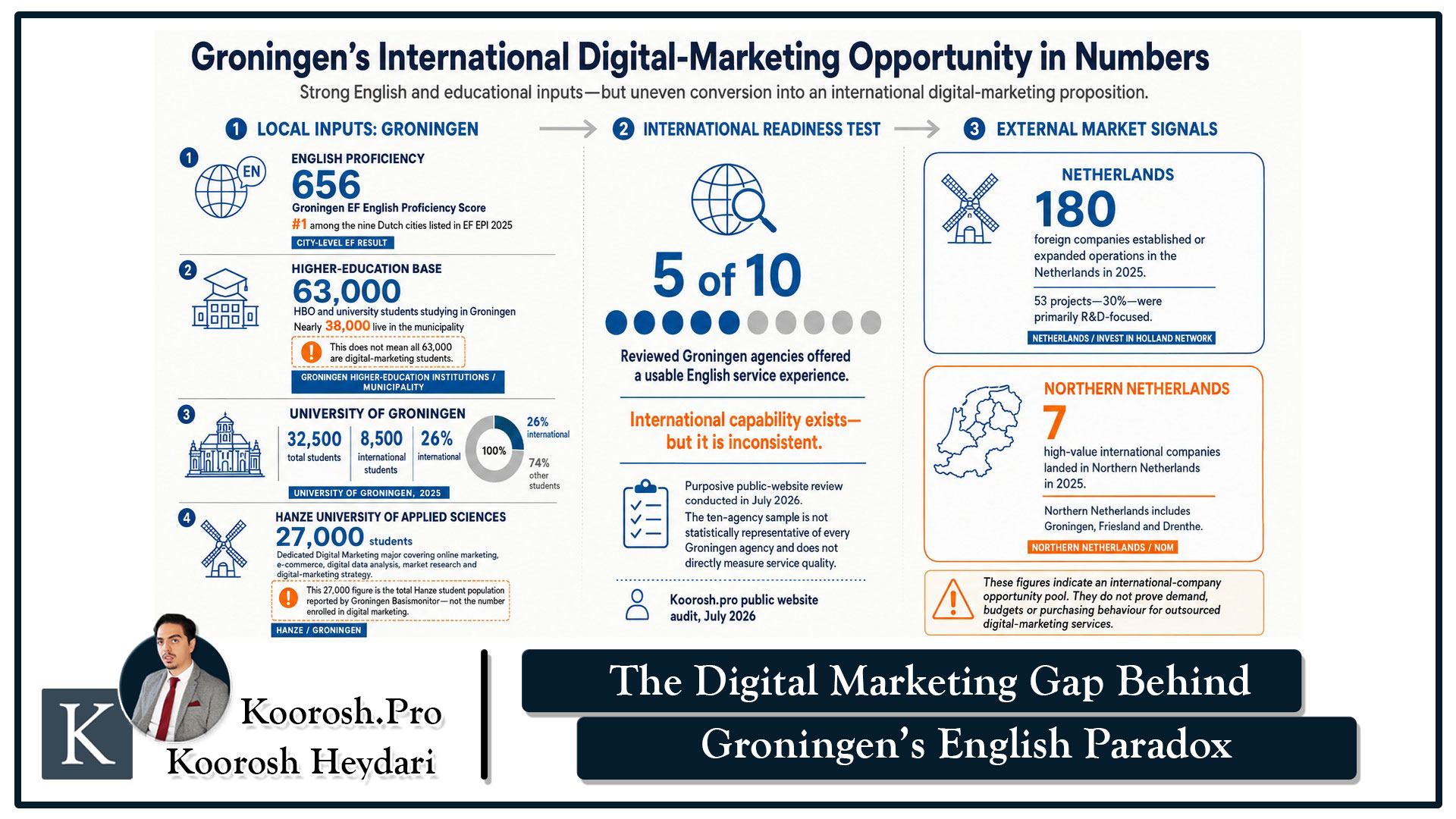
- 656: Groningen’s English score—the highest among the nine Dutch cities in the EF English Proficiency Index 2025.
- 63,000: students studying at higher-education institutions in Groningen; nearly 38,000 live in the municipality, according to the Groningen Basismonitor.
- 5 out of 10: agencies in our public website review with a usable English-language service experience.
- 180: foreign companies that established or expanded operations in the Netherlands in 2025, reported by Invest in Holland.
- 7: high-value international companies reported by NOM as landing across the three Northern Netherlands provinces in 2025.
These figures describe potential, not a finished market. English proficiency is not professional copywriting. Student volume is not a guaranteed talent supply. Foreign investment is not proof of outsourced marketing demand. An English website is not proof that an agency can win and retain international clients.
Those distinctions matter because this opportunity is real only if Groningen can convert capacity into demand, and demand into profitable client relationships.
Groningen genuinely has the raw material
The headline statistic is legitimate, with one important qualification.
In the EF English Proficiency Index 2025, Groningen scored 656, ahead of Utrecht at 638, Eindhoven at 636 and Amsterdam at 630. The Netherlands ranked first globally with a national score of 624.
That does not prove that every resident of Groningen speaks better English than every resident of Amsterdam. EF’s index is based on people who chose to take its online test. Its methodology states that the sample is self-selected, younger than the general population and not guaranteed to be representative. A city needs only 100 test-takers to be included.Still, the result is useful. It indicates that Groningen has an unusually strong base of English competence—the first requirement for an English-first service sector.
The second requirement is talent. According to the Groningen Basismonitor, approximately 63,000 higher-education students study in the city, and nearly 38,000 live in the municipality. The University of Groningen’s 2025 key figures report 32,500 students, including 8,500 international students, or 26% of the total. Hanze adds a practical marketing pipeline. Its four-year Digital Marketing major covers online marketing, e-commerce tools, data analysis and digital-marketing strategy. Hanze also offers an English-taught Marketing Management bachelor built around international project teams, real clients and internships.The city also has real commercial depth. Groningen’s municipal research office counted almost 27,000 business establishments and nearly 177,000 jobs by April 2024 in its 2025 state-of-the-city report.
Most importantly, Groningen has proof that digital companies can scale beyond the region. Gomibo Group—the company behind Belsimpel—reports €606 million in 2025 revenue, 600 employees and operations in more than 27 European countries, while retaining its base in Groningen. That does not prove agency capability. E-commerce operations and client services are different businesses. But it does remove one weak objection: Groningen’s geography does not prevent a digital company from building at European scale.
The English score for international digital marketing ?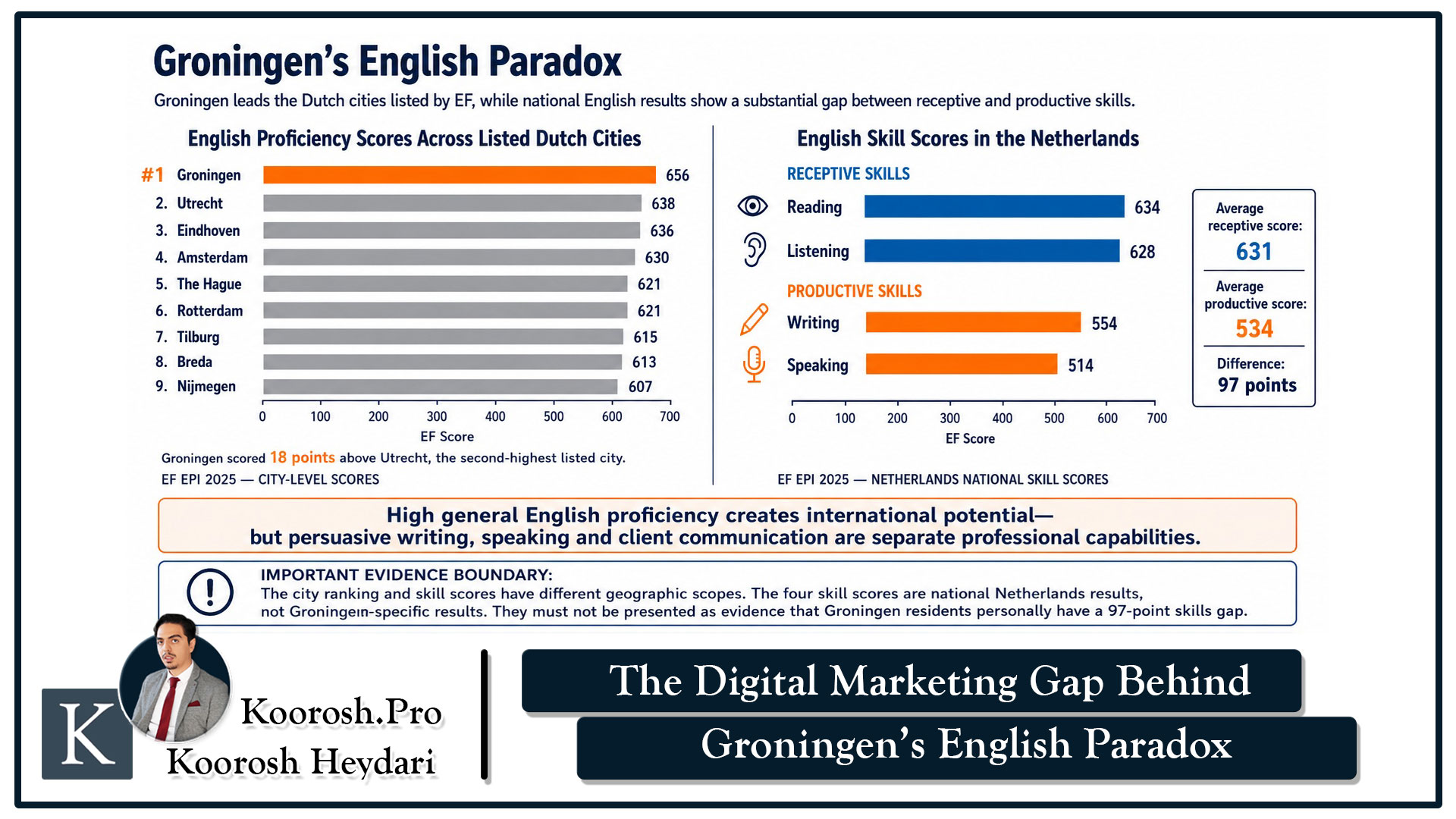
English proficiency is easy to overvalue in marketing.
At the Dutch national level, EF reports stronger receptive skills than productive ones: reading scored 634 and listening 628, while writing scored 554 and speaking 514. The gap does not invalidate Groningen’s advantage, but it changes its meaning.
An international agency does not merely need employees who can understand English. It needs people who can:
- conduct a discovery call with a foreign founder;
- write persuasive copy without sounding translated;
- explain Dutch consumer behaviour to an outsider;
- defend a strategy in English;
- localise a proposition without flattening its meaning;
- produce research that search engines and AI systems can retrieve and cite.
General fluency is the foundation. Professional production is the sellable capability.
This is why Groningen’s student population should not be treated as an automatic labour supply. The local education base is large and relevant, but enrolment pressure is moving in the wrong direction. The Basismonitor says the city’s long-running increase in student numbers has recently shifted into decline. Nationally, the Ministry of Education forecasts higher-professional-education enrolment falling from 449,200 in 2024 to 412,800 in 2031, and university enrolment falling from 339,600 to 313,000 over the same period (OCW reference forecast 2025).
Groningen has a talent advantage, but it cannot assume that the pipeline will keep expanding.
The agency market is not a void
To test the supply side, I reviewed the public websites of ten agencies with a stated Groningen office or base across SEO, growth marketing, content, digital development and full-service online marketing.
The question was deliberately simple: could an English-speaking buyer find a usable English service experience—not merely an English contact line or an isolated article?
SmartRanking presents a complete English proposition for international SEO and generative-engine optimisation, and says it serves companies across Europe and North America. iWink provides a full English site for its digital services. Concept7 offers an English service and case-study experience. Sprints & Sneakers operates an English-first growth-marketing site and lists a Groningen office. KYO markets English content production from a Groningen base.
On the other side, the public experiences reviewed for theFactor.e, TriplePro, ON. Digital Marketing, Tomorrowmen and Convident were primarily Dutch-facing when checked in July 2026. Some state that they can work nationally or internationally; that is not the same as giving an international buyer a complete English route from problem to proof to contact.
This was a purposive sample, not a census, so 4 out of 10 should not be presented as the citywide market share. It does, however, disprove the strongest version of the “void” thesis.
Groningen already contains internationally usable agencies. What it lacks is consistent category ownership.
Only part of the market clearly connects all four elements a foreign entrant would value:
- Dutch market intelligence;
- English-language strategy and delivery;
- international SEO and AI-search visibility;
- evidence that reduces the risk of hiring an agency outside Amsterdam.
That is a positioning gap, not a capability vacuum.
There is demand—but public data cannot tell us how much
Foreign companies continue to enter the Netherlands. The Netherlands Foreign Investment Agency reported that 180 foreign companies established or expanded Dutch operations in 2025. Fifty-three of those projects—30%—were primarily focused on research and development (Invest in Holland, 2025 results).
In the Northern Netherlands, NOM reported that seven high-value companies landed across Groningen, Friesland and Drenthe in 2025, as part of a wider package of almost €100 million in investment and project value (NOM 2025 results).
These are useful demand indicators, but they do not show:
- how many entrants outsource digital marketing;
- what they spend;
- whether they prefer Amsterdam agencies;
- how much they value a local office;
- which services they buy first;
- whether English is enough or multilingual delivery is required.
Without interviews or private purchasing data, it would be misleading to turn investment projects into an estimated agency market in euros. What we can say is simpler: every foreign company entering the Netherlands faces some combination of market research, local positioning, search visibility, content localisation, analytics and customer acquisition. That creates a plausible buyer problem. Groningen still has to prove it can access those buyers efficiently.
“Cheaper than Amsterdam” is not a strategy
The cost argument is attractive because it is easy to explain: locate the team in Groningen, pay lower salaries and rent, then undercut Amsterdam while protecting margins.
The public evidence is not strong enough to support that model confidently.
Comparable public data on agency rates, utilisation, seniority mix, recruitment costs and international client-acquisition costs is limited. Even where Groningen is cheaper, remote hiring makes salary differences less local, and specialist English, SEO, analytics and AI-search talent can command a national or international rate. Groningen is not a market of unlimited cheap capacity either. The municipal research office reported around 21,000 open vacancies in Groningen and Drenthe in 2024, nearly twice the pre-pandemic level. It also reported business-space vacancy below the 5% level considered healthy (OIS Groningen).
The better commercial position is therefore not:
Amsterdam quality at Groningen prices.
It is:
Dutch and European market intelligence, delivered in English through specialist search and measurement expertise.
Cost efficiency can support that proposition. It should not be the proposition.
Where the real digital-marketing gap sits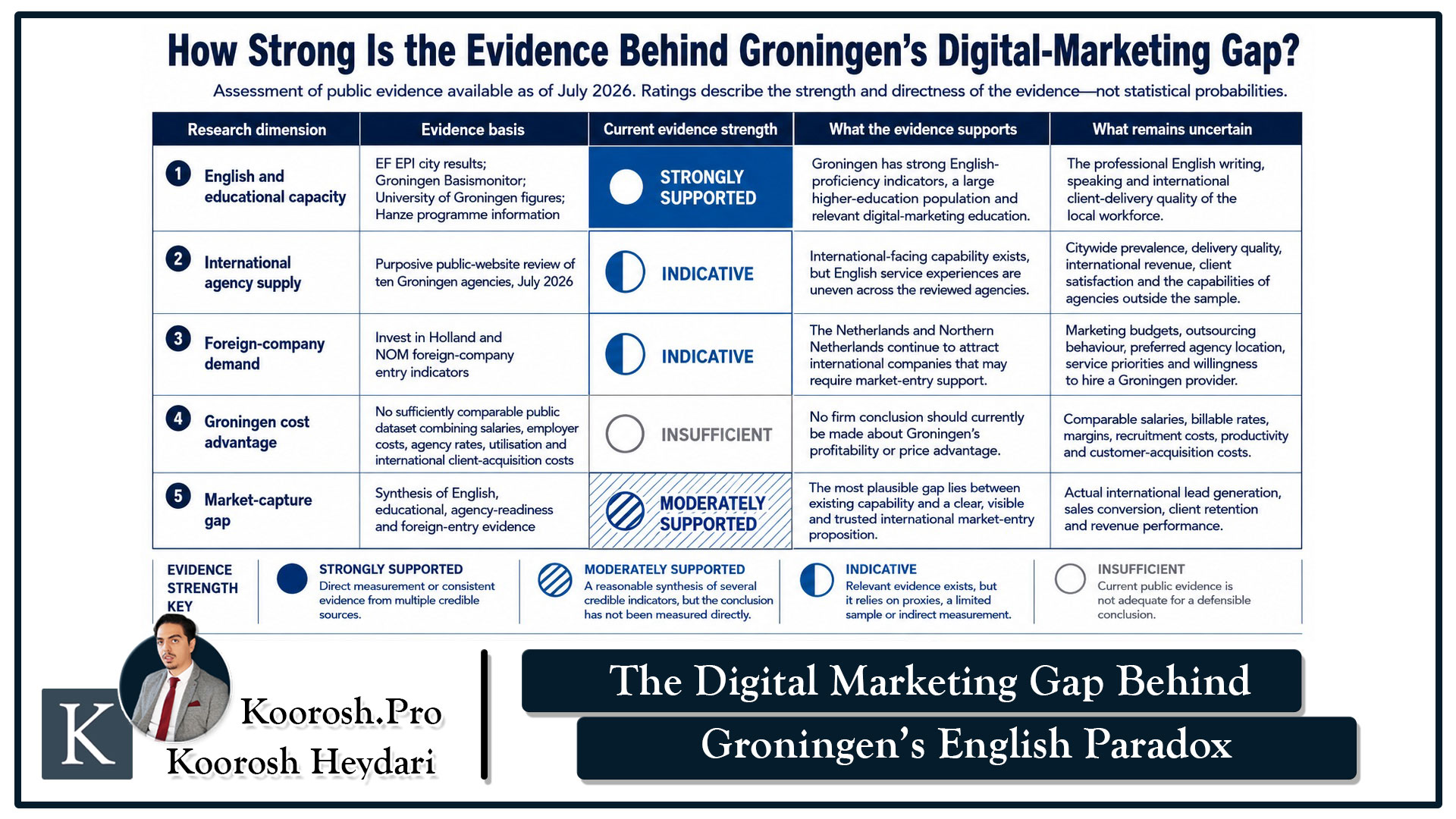
The evidence points to a gap between capability and market capture.
Groningen has English competence, relevant education, established agencies and proof of European digital execution. Foreign companies continue to establish themselves in the Netherlands. Yet the city does not own a memorable international category. The most defensible opportunity is not another generalist agency with an English homepage. It is a specialist market-entry and organic-growth proposition for foreign SMEs and scale-ups that need to understand the Netherlands before expanding further into Europe.
Recommended service system For Digital Marketing in Groningen
Its service system could combine:
- Dutch market and competitor research;
- international SEO and technical search audits;
- Dutch localisation and English content strategy;
- AI-search visibility, including answer-ready evidence and entity authority;
- multilingual expansion planning;
- analytics, attribution and a measurable 90-day growth roadmap.
A productized first offer
The first offer should be finite and low-risk: a Dutch Market-Entry Visibility Sprint.
In two to four weeks, the client receives a market map, search-demand analysis, competitor review, localisation risks, AI-answer visibility check and a prioritised 90-day plan. That is easier to buy than an open-ended retainer, creates evidence for both sides and can lead naturally into execution.
Distribution and partnerships
Distribution matters as much as delivery. The likely acquisition channels are not generic international keywords alone. They are partnerships with investment agencies, company-formation specialists, accountants, lawyers, relocation firms, startup networks and university-linked business organisations—the people foreign entrants trust before choosing a marketing supplier.
This is the missing commercial bridge in the Groningen story.
What foreign companies should look for
An international buyer should not choose a Groningen agency merely because the city scores well in English or costs less than Amsterdam.
It should ask for:
- an English discovery and reporting process;
- evidence of work across countries or languages;
- a clear distinction between translation and localisation;
- Dutch market knowledge that changes the strategy;
- SEO capability across technical, content and authority work;
- a defined method for AI-search monitoring rather than vague “GEO” promises;
- measurement tied to qualified demand, not rankings alone.
For Groningen agencies, the mirror image is equally practical: publish complete English service journeys, show international cases, explain the Dutch market to outsiders and build a proposition around a buyer problem—not around being from Groningen.
Final verdict: gap, not void
Groningen’s English paradox is real, but not for the reason I expected.
The city is not failing because it lacks English-speaking marketers or capable digital agencies. Half of the ten agencies in this review already offered a usable English experience, and some demonstrate credible international SEO, content or growth capability.
The failure is one of conversion.
Groningen has not consistently converted English proficiency into professional international production, student scale into a secure specialist pipeline, foreign investment into an accessible client channel, or digital expertise into a category the market immediately understands.
That leaves a genuine opportunity—but not an effortless one.
The winning agency will not be the cheapest generalist in the north. It will be the specialist that makes the Netherlands understandable, searchable and commercially accessible to foreign companies—then uses Groningen’s talent and operating environment to deliver that promise well.
That is the digital-marketing gap behind Groningen’s English paradox.
Method and limitations
This article combines public data available through July 2026 with a manual review of ten agency websites. The municipality of Groningen is the primary geography; Northern Netherlands figures are explicitly labelled. The agency sample was selected to test visible international readiness and is not statistically representative. “English experience” means that an English-speaking buyer could navigate a meaningful service proposition; it does not verify delivery quality, client revenue or organic-search performance.
No interviews, private agency financials or paid SEO-platform data were used. Foreign-investment figures indicate potential market-entry demand but do not prove outsourced marketing budgets or buying behaviour. EF English results come from self-selected test-takers and should not be treated as a population census.

Senior Digital Marketing Strategist
Over the past 12+ years, I’ve held many titles in digital marketing and online business development. I’ve learned from experienced people, taught students, mentored interns, led managers, built teams, made mistakes, and occasionally discovered ideas that worked surprisingly well. I’m still learning, still experimenting, and still excited to share my thoughts.